Editorial Picks
7 Late-Night Street Food Picks in Myeongdong, Seoul — Saki's Guide
An editor's walk through the Myeongdong night market — seven carts I send Japanese visitors to, from tornado potato to bungeoppang, between Myeongdong Station Exit 6 and the Cathedral.
Myeongdong at dusk is the closest Seoul comes to the Dotonbori I remember from student trips — narrower, more vertical, but the same conviction that an evening properly begins with something hot pressed into a paper cone and eaten standing up. The carts arrive in the late afternoon, the lights come up around six, and by seven the avenue between Myeongdong Station Exit 6 and Myeongdong Cathedral is the most concentrated stretch of street food in central Seoul. I came back to walk it again last winter, twelve years after my first visit, and the seven entries that follow are the ones I stopped at twice. The list is editorial — not a ranking — and it reads from the station outward, in roughly the order a visitor would walk after stepping out of Exit 6 around eighteen-thirty. Pricing is modest: most items sit between two thousand and ten thousand won, with one premium outlier near the Cathedral. Cash is welcomed everywhere; the larger carts now accept card and even Alipay. Most stalls keep English, Mandarin, and Japanese picture menus, and the older vendors will smile at a quiet konnichiwa. The night market peaks between seven and ten in the evening; arrive earlier for the seasonal carts that sell out by eight, later for the quieter pace.
How this list was put together
I walked the Myeongdong night market across three separate evenings over a two-week editorial window, between five-thirty and ten-thirty in the evening, and tasted each item at two different carts where the same dish was available from multiple vendors. The brief was specific. The seven entries had to be street food in the literal sense — prepared at an outdoor cart, served in a paper sleeve or on a skewer, intended to be eaten on the move or at one of the small standing counters. They had to be widely documented across at least two of VisitSeoul, Time Out Seoul, CNN Travel, or the Korea Tourism Organization, so that a foreign reader cross-checking the list could verify each entry against a primary source. They had to be reliably present along the Myeongdong-gil and Myeongdong 8-gil corridor — not single-vendor cult items but established carts with multiple operators, so that a visitor on any given night could find the item without the kind of cart-chasing that defeats the purpose of street food. And they had to be approachable for first-time visitors, which in practice meant items with picture menus, English item names, and serving sizes that suit a stand-up meal rather than a destination dinner. I avoided ranking by quality, which in the case of street food made by dozens of small operators is a slightly false exercise; the order below is geographical, station-out, and reflects the order in which a walking visitor would encounter the carts. The list holds at seven because seven is the number of distinct dishes an unrushed visitor can comfortably taste across a single evening without losing appetite or compromising sleep. Price tiers are notional — yen-equivalents are appended in the comparison table for Japanese readers — and reflect the price of a single serving rather than the menu's ceiling. No vendor on this list knew this piece was being written; no inclusion was paid for; no item is on the list because of a relationship with the cart.
- Verified against two or more travel-press primary sources
- Reliably present along Myeongdong-gil or Myeongdong 8-gil
- Picture menu and English item name available
- Prepared at the cart, not pre-warmed in a tray
- Suitable for stand-up eating, modest portion size
Featured A — Myeongdong Night Market opening stretch
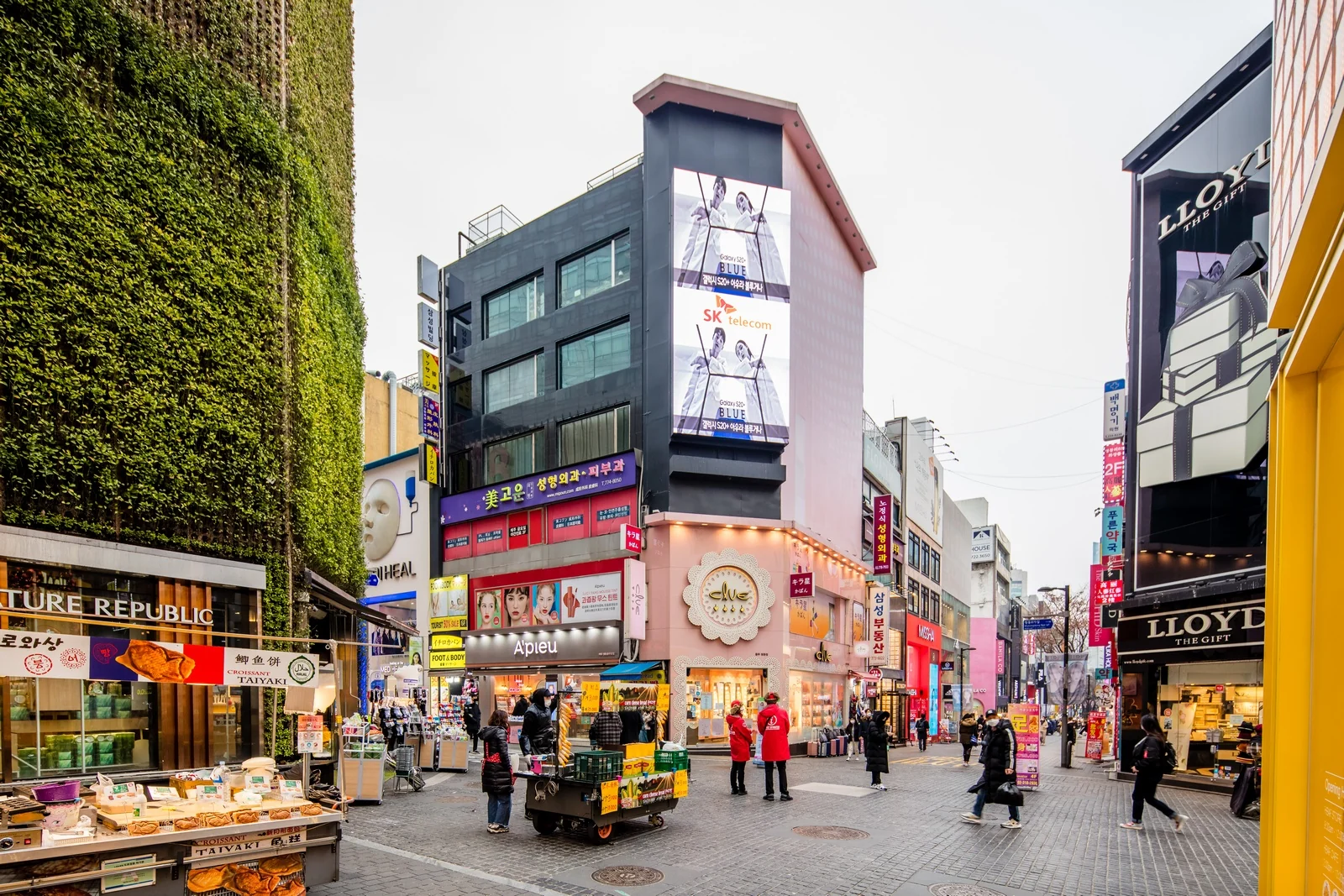
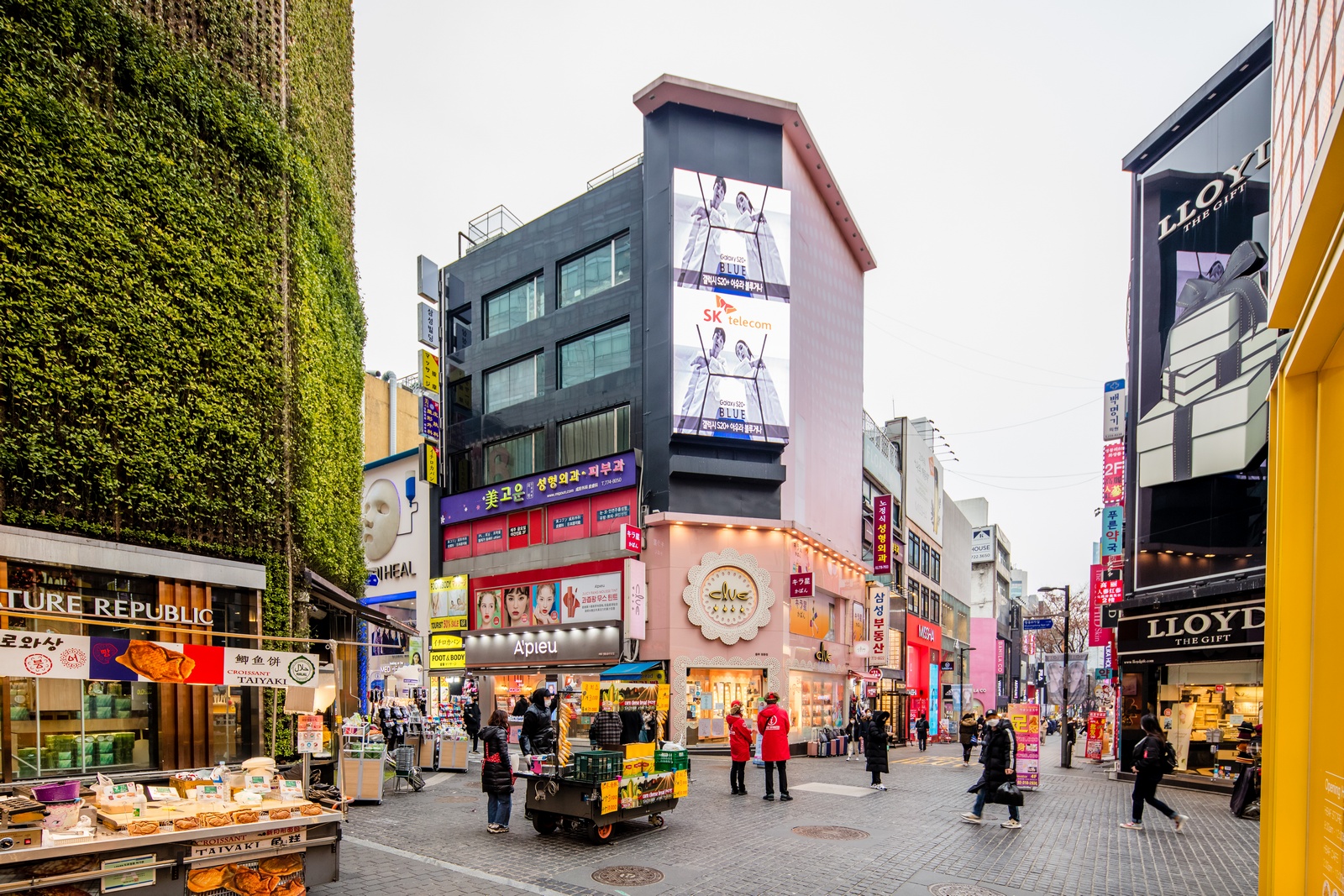
The Myeongdong night market is less a single venue than a stretch — the carts that gather along Myeongdong-gil and Myeongdong 8-gil between Myeongdong Station Exit 6 and Myeongdong Cathedral, lit from approximately four in the afternoon and trading through to about eleven in the evening. The concentration here is, in my editorial experience, the largest of any central Seoul night-food district, and for a first-time visitor it is the right place to begin. The pace is approachable. Most carts hand-letter their prices in English, accept either cash or card, and keep picture menus with the dish name in English, Japanese, and Mandarin. The first stretch — about a hundred and fifty metres north from Exit 6 — gathers a representative mix of the dishes that follow on this list, and a slow ten-minute walk along it will give a visitor a sense of which items appeal before any committed ordering. The atmosphere is warmer than the brightly-lit shopping arcades that flank it: the carts cluster, the smoke rises, the lights pool. I have, over the years, sent friends and editors here as their first Seoul evening and have not yet had one return disappointed. The carts here open in the late afternoon and trade most reliably between six and ten in the evening; the older vendors close earlier, the newer ones run later. Address: Myeongdong-gil, Jung-gu, Seoul, in the corridor between Myeongdong Station Exit 6 and Myeongdong Cathedral. Hours: approximately sixteen-hundred to twenty-three-hundred daily, peak after eighteen-hundred. Price range: two thousand to ten thousand won per item, roughly two hundred to one thousand yen at current rates. Foreigner support: English, Mandarin, and Japanese basic menu cards on most carts. Documented in VisitSeoul, Time Out Seoul, and the Korea Tourism Organization English portal.
Featured B — Tornado Potato, the spiral on a skewer
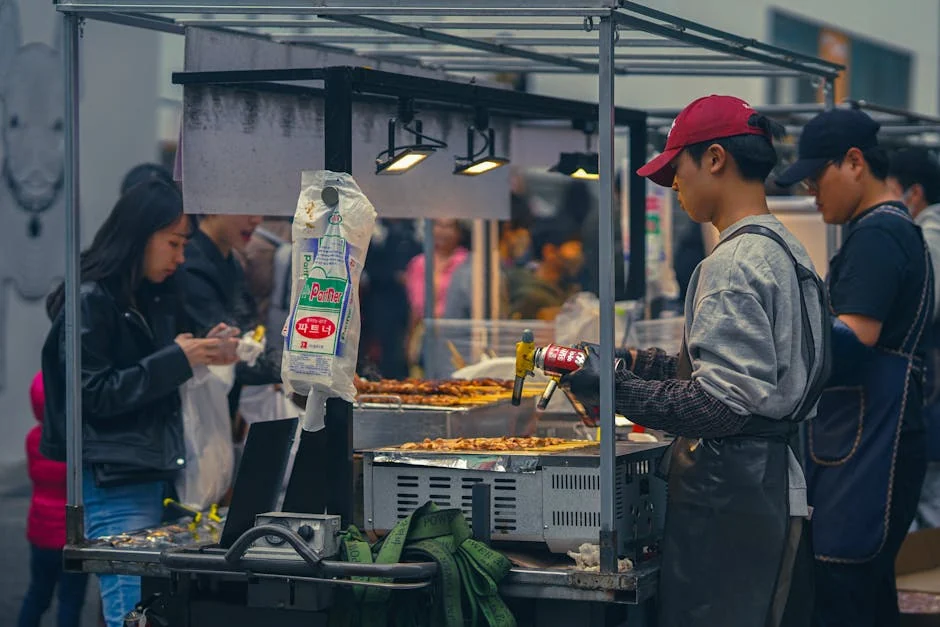
Tornado potato — hoedori gamja in Korean, the spiral-cut potato deep-fried on a wooden skewer and seasoned at the counter — is the dish a first-time visitor sees on Instagram before they see Seoul, and the dish a returning visitor reorders out of affection rather than novelty. The preparation is technical and slightly theatrical. A whole potato is mounted on a vertical lathe at the cart, a single curved blade cuts a continuous spiral the length of the potato, the spiral is stretched and threaded onto a long bamboo skewer, the assembly is dropped into hot oil and emerges three minutes later as a crisp, golden, accordion-shaped object that one seasons from a menu of about a dozen powders — barbecue, cheese, honey-butter, garlic, original. The cheese-powder version is the most photographed; the honey-butter version is, in my view, the more interesting choice. The carts that prepare hoedori gamja best are clustered along the central section of Myeongdong-gil between the cosmetics flagships, and the dish is reliably available from about fourteen-hundred until twenty-three-hundred. Pricing is consistent across carts at four to five thousand won — roughly four to five hundred yen — and most vendors accept both cash and card. The picture menus are universal; pointing works perfectly. The skewer is long, the potato hot, and the seasoning powder generous; a paper napkin is provided, and an eating area at the side of most carts allows a brief standing pause. The dish is the most internationally documented Myeongdong street snack, covered by CNN Travel, Time Out Seoul, and VisitSeoul among others, and it is the item I would put first on any visitor's omiyage of evening photographs. The flavour reads, to a Japanese palate, as a Korean cousin of jagaimo karaage — denser, more theatrical, more aggressively seasoned, but recognisable in its register. Address: multiple carts along Myeongdong-gil, Jung-gu, Seoul. Hours: approximately fourteen-hundred to twenty-three-hundred. Price range: four thousand to five thousand won. Foreigner support: picture menus, cash and card accepted at most carts. Documented in Time Out Seoul, VisitSeoul, and CNN Travel.
Featured C — Egg bread, the warm pocket for cold evenings
Egg bread — gyeranppang, an oval roll of mildly sweet batter baked to order from individual cast-iron molds with a whole egg cracked into the top and finished in the heat — is among the gentlest entries on this list, and the dish I most often recommend for a visitor's first item of the evening. The proposition is sweet-savoury, soft, and warming, and the format suits a cold-weather Myeongdong walk in a way the deep-fried items do not. The batter is mildly sweet, mildly egg-rich, faintly buttery; the topping egg is barely set on emergence, with a yolk that retains a slight gloss and a white that is just firm. Carts serve them three or four to an order, in a paper sleeve, and the bread is at its peak in the first ninety seconds after it leaves the mold. The seasonal calibration matters: gyeranppang is a year-round item, but it is at its psychological best between November and March, when the cart's heat and the warmth of the bread combine into something close to a small comfort. Most vendors offer a plain version and a cheese version; I would order the plain first and the cheese only if the appetite genuinely extends. The carts cluster along Myeongdong-gil and Myeongdong 8-gil, and pricing is consistent at two to three thousand won per piece — roughly two to three hundred yen. Picture menus are standard. The dish is widely documented across VisitSeoul and Time Out Seoul, and it is the entry on this list that reads most like an ekiben-cousin to a Japanese reader: handheld, warming, modestly priced, and immediately recognisable as the kind of small portable food that anchors a working evening. Address: Myeongdong-gil and Myeongdong 8-gil, Jung-gu, Seoul. Hours: approximately sixteen-hundred to twenty-three-hundred. Price range: two thousand to three thousand won. Foreigner support: picture menus standard. Documented in VisitSeoul and Time Out Seoul.
Featured D — Hotteok, the brown sugar pocket
Hotteok — a pan-fried sweet pancake stuffed with brown sugar, chopped peanuts, sunflower seeds, and a measure of cinnamon — is the entry on this list that most clearly belongs to winter, and the dish I would put at the centre of any cold-weather Myeongdong itinerary. The preparation is a small piece of street theatre: a ball of leavened dough is flattened on a hot, lightly oiled griddle, a spoonful of the brown-sugar-and-seed filling is enclosed inside, and the pancake is pressed with a vented flat-iron until the sugar melts and the edges crisp. The vendor lifts the hotteok with tongs, snips one corner with kitchen scissors so that the visitor can pour out the melted filling slowly rather than scorch their mouth on contact, slides it into a folded paper sleeve, and hands it across. The first bite is the best one, taken at a slight angle from the snipped corner. The filling is hot enough to demand respect — I have watched more than one tourist mismanage the first bite and learn the lesson — but the heat is also the point, and the contrast between the cool winter air and the molten sugar inside the bread is the small drama the dish exists for. Pricing sits at two thousand to four thousand won, roughly two hundred to four hundred yen, and carts trade most reliably between sixteen-hundred and twenty-two-thirty. Cash is preferred; some larger carts now take card. The dish is universally documented — CNN Travel, VisitSeoul, the Korea Tourism Organization — and it is the Myeongdong street item that most reliably appears on global lists of essential Korean street food. To a Japanese palate the closest analogue is imagawayaki in its sweet-pocket character, though the texture is denser and the heat far more committed. Address: Myeongdong-gil, Jung-gu, Seoul. Hours: approximately sixteen-hundred to twenty-two-thirty. Price range: two thousand to four thousand won. Foreigner support: cash preferred, some card. Documented in CNN Travel and VisitSeoul.
Featured E — Tteokbokki, the spicy rice cake station
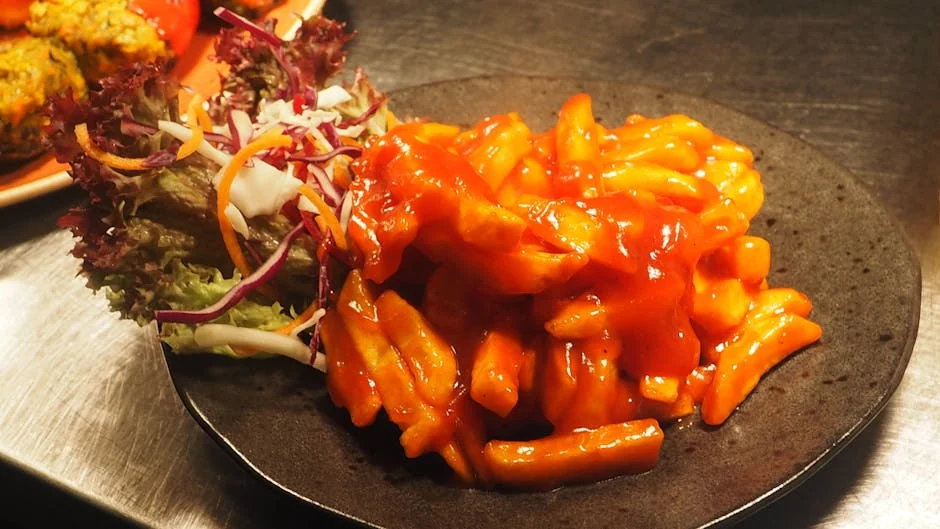
Tteokbokki — cylindrical rice cakes simmered in a sauce of gochujang, gochugaru, sugar, and a measure of stock, served from a wide open griddle that holds the dish near boil — is the signature Korean street food and the one item on this list that a visitor must approach with a clear sense of their own spice tolerance. The dish is, by default, spicy. Not the throat-grasping spice of dedicated chilli specialists, but a steady, sweet, garlicky heat that builds across a serving and continues to develop for several minutes afterward. Most Myeongdong vendors pair the rice cake with eomuk (fishcake sheet in clear broth) and twigim (assorted fried items — sweet potato, glass noodle, dumpling — that one dips into the tteokbokki sauce), and the trio constitutes the canonical street-stall order. The portions are generous; a serving for one is typically enough to share, and the carts provide small paper cups for the eomuk broth on the side. Most stalls keep a picture menu with English item names. Pricing is consistent at three thousand to six thousand won, roughly three hundred to six hundred yen. Carts trade between sixteen-hundred and twenty-three-hundred. The dish is universally documented; VisitSeoul, the Michelin destination pages for Seoul, and Time Out Seoul all reference it as the central Korean street-food reference. For a Japanese reader, the closest analogue is oden in format — a simmered stall dish, eaten standing — but the spice register is unfamiliar, and a first-timer should ask for a small portion to test their tolerance before committing. The eomuk broth alongside, salted and faintly anchovy-tinged, is the gentlest companion and the dish I would order parallel for any visitor still acclimating to gochujang heat. Address: Myeongdong-gil, Jung-gu, Seoul. Hours: approximately sixteen-hundred to twenty-three-hundred. Price range: three thousand to six thousand won. Foreigner support: picture menus, English item names common. Documented in VisitSeoul and Michelin's Seoul destination pages.
Featured F — Grilled cheese lobster, the photographed splurge
Grilled cheese lobster — half a Boston lobster split lengthways, butterflied, and finished on the open griddle under a thick blanket of melted mozzarella — is the entry on this list that breaks the modest pricing of the rest of the night market, and the entry that exists primarily as a piece of Instagram theatre. The dish is, in raw culinary terms, a competent piece of cooking — the lobster is grilled until just opaque, the cheese is browned to a soft caramel under the cart's small salamander, the assembly is seasoned with a measure of garlic butter and finished with a sprinkle of chopped scallion — and it is, in commercial terms, the cart that holds the longest queue along the busier section of Myeongdong-gil after dark. The price is the consideration: fifteen thousand to twenty-five thousand won, roughly fifteen hundred to twenty-five hundred yen, and the dish reads as a small splurge rather than a casual stop. The cart holds a steady line between seventeen-hundred and twenty-two-thirty, and the wait is, on a busy evening, ten to fifteen minutes. The carts maintain picture menus and accept English and Mandarin orders; staff are accustomed to the photographic ritual the dish exists for and will hold the assembly briefly under the cart's lights for a clean shot before passing it across. The cheese-lobster pairing is unique to the Myeongdong night market — I have not seen the dish executed at this scale in any other Korean street-food district — and it functions as the photographed centrepiece of the corridor. For a Japanese visitor the closest reference is the grilled scallop carts of Tsukiji's outer market, though the Myeongdong version is more cheese than seafood by both weight and cost. Address: Myeongdong-gil, Jung-gu, Seoul. Hours: approximately seventeen-hundred to twenty-two-thirty. Price range: fifteen thousand to twenty-five thousand won. Foreigner support: picture menus, English and Mandarin. Documented in Time Out Seoul and VisitSeoul.
Featured G — Bungeoppang and gungmulppang, the seasonal closer
Bungeoppang — fish-shaped sweet pancake with a red-bean or custard filling — and its slightly older cousin gungmulppang — the chrysanthemum-shaped variant — are the most seasonal entries on this list and the items I would treat as the closing piece of an evening rather than the opening. The carts are primarily a cold-weather phenomenon. They appear around late October as the temperature drops, hold the corridor through to early March, and disappear again with the spring; in the warmer months one can find them only at the most determined vendors. The preparation is closer to a baked goods operation than to a hot griddle: a leavened wheat-and-rice batter is poured into individual fish-shaped molds on a rotating iron, a spoonful of red bean paste or custard is enclosed at the centre, and the assembly is closed and held over heat for several minutes until the bread is golden and the filling is hot through. The fish shape is the older and more traditional; the chrysanthemum is the rounder, slightly fancier version. Pricing is among the most modest on the list at one thousand to two thousand won per piece, roughly one hundred to two hundred yen, and the carts are reliably cash-only. The dish trades between fifteen-hundred and twenty-two-hundred in the colder months, and the older vendors will close as soon as the batter runs out. The format is portable; one walks with the bag, taking pieces from the top as the corridor unwinds toward the Cathedral. To a Japanese reader the resemblance to taiyaki is immediate — same fish shape, same red-bean filling, same seasonal calibration — and the Myeongdong version is, in my comparative view, a touch denser and a touch sweeter, with a slightly thinner shell than its Tokyo cousin. The dish is documented across VisitKorea and VisitSeoul, and it is the entry on this list that most clearly belongs to the local winter rhythm rather than to the tourist itinerary. Address: Myeongdong-gil and outside Myeongdong Station, Jung-gu. Hours: seasonal, primarily October to March, fifteen-hundred to twenty-two-hundred. Price range: one thousand to two thousand won. Foreigner support: cash preferred. Documented in VisitKorea and VisitSeoul.
Comparison at a glance
The table below summarises the seven entries on a small set of practical attributes a Japanese visitor is likely to weigh — the dish category, the typical price in won with an approximate yen equivalent, the trading hours of the most reliable vendors, and a notional season note. None of these are formal ratings; all are editorial impressions from three walking evenings across a winter editorial window.
| Featured | Item | Category | Price (KRW) | Price (JPY approx.) | Reliable hours | Season |
|---|---|---|---|---|---|---|
| A | Myeongdong Night Market opening stretch | Cart corridor | ₩2,000-10,000 | ¥200-1,000 | 16:00-23:00 | Year-round |
| B | Tornado potato | Deep-fried snack | ₩4,000-5,000 | ¥400-500 | 14:00-23:00 | Year-round |
| C | Egg bread (gyeranppang) | Baked savoury-sweet | ₩2,000-3,000 | ¥200-300 | 16:00-23:00 | Year-round, peak winter |
| D | Hotteok | Pan-fried sweet pancake | ₩2,000-4,000 | ¥200-400 | 16:00-22:30 | Year-round, peak winter |
| E | Tteokbokki | Spicy rice cake stall | ₩3,000-6,000 | ¥300-600 | 16:00-23:00 | Year-round |
| F | Grilled cheese lobster | Premium photographic item | ₩15,000-25,000 | ¥1,500-2,500 | 17:00-22:30 | Year-round |
| G | Bungeoppang / gungmulppang | Seasonal fish-shape pancake | ₩1,000-2,000 | ¥100-200 | 15:00-22:00 | October-March |
How to walk the corridor
A pragmatic note for the visitor who would rather walk the corridor than read about it. Begin at Myeongdong Station Exit 6, which empties directly into the southern end of Myeongdong-gil. Walk north toward Myeongdong Cathedral, keeping to the right-hand side of the avenue for the first three or four carts, then crossing at the next intersection. The corridor is approximately five hundred metres end to end and takes a slow walker thirty to forty minutes; an unhurried tasting walk with stops at four or five carts will absorb a comfortable hour and a half. Cash matters less than it once did — most carts now accept both Korean cards and at the larger vendors Alipay, WeChat Pay, and Apple Pay — but a small reserve of ten-thousand-won notes simplifies the smaller transactions. Bring a printed itinerary or save the items to a phone in Korean (the carts' hand-lettered signs sometimes read more clearly in hangul than in romanisation), keep a packet of tissues for sticky fingers, and budget more time than the map suggests; the carts run on relaxed Korean street-market time rather than train-schedule time. For evening logistics, the corridor connects on its northern end to the cluster of casual dining and dessert cafes around the Cathedral, and on its southern end to the underground passage that leads back to Myeongdong Station and the Lotte Hotel Seoul precinct. A walking visitor staying at any central-Seoul hotel can return on foot or by the same subway line within fifteen minutes.
Frequently asked
Eight common questions from Japanese and other visiting eaters.
“The carts arrive in the late afternoon, the lights come up around six, and by seven Myeongdong is the closest Seoul comes to the Dotonbori I remember from student trips.”
Saki Watanabe, Myeongdong notebook
Frequently asked questions
What time does the Myeongdong night market start and finish?
Most carts come up between fifteen-hundred and sixteen-hundred and trade through to about twenty-three-hundred, with the densest concentration of vendors between seventeen-hundred and twenty-one-hundred. The seasonal carts — bungeoppang and gungmulppang in particular — pack up earlier, often by twenty-two-hundred, especially on weeknights.
How much should I budget for an evening of street food?
A comfortable tasting walk across five to six items lands at twenty thousand to thirty thousand won per person, or roughly two to three thousand yen at current rates. Adding the grilled cheese lobster pushes the total closer to forty-five thousand won, and skipping it returns the budget to the lower end.
Do the carts accept card or only cash?
The larger carts now accept Korean credit cards and at the busier stalls Alipay, WeChat Pay, and Apple Pay. The older single-operator carts — particularly for hotteok and bungeoppang — remain cash-preferred. Keeping a small reserve of ten-thousand-won notes simplifies the smaller transactions.
Is there an English or Japanese menu at the carts?
Most carts maintain a picture menu with English, Mandarin, and Japanese item names. The older vendors will respond to a Japanese greeting, though the conversational range is limited. Pointing at the picture and stating the seasoning preference works at every cart on this list.
How spicy is the tteokbokki and can I ask for a milder version?
Tteokbokki is sweet-spicy by default, with a steady gochujang heat that builds across a serving. Some carts will reduce the sauce on request, but the dish does not work without it. A first-timer with low spice tolerance should ask for a small portion and pair it with the milder eomuk broth that most carts serve alongside.
Can I find these dishes in winter and summer equally?
Most items are year-round — tornado potato, tteokbokki, egg bread, hotteok, lobster, and the night market corridor itself. Bungeoppang and gungmulppang are firmly seasonal and appear primarily from October through March. The hotteok carts also expand notably in colder months when the warmth of the dish suits the weather.
Is the grilled cheese lobster worth the price?
For the photograph and the experience of the Myeongdong night market's most theatrical dish, yes. For the cooking alone, it is competent rather than exceptional. I would treat it as a small splurge once per trip rather than a default order, and a first-time visitor should not skip it on price grounds; fifteen thousand won is a modest indulgence by central Seoul standards.
Where do I start the walk and how long does it take?
Begin at Myeongdong Station Exit 6 and walk north toward Myeongdong Cathedral along Myeongdong-gil. The corridor is approximately five hundred metres end to end. An unhurried tasting walk with stops at four to five carts absorbs about ninety minutes, and the route connects on the northern end to the Cathedral and on the southern end back to the station.